Showing posts with label guest blogger. Show all posts

Sunday, August 7, 2011

It a Cassia's Garden Giveaway!

Cassia's Garden Giveaway
So those of you that read my Facebook know that I had the honor of being featured on August 1 at Sonya's blog Kanelstrand Organic Living.

I am so pleased to meet awesome friends & fellow artists on the blogosphere, through Etsy and other handmade sites!  The mutual admiration and respect goes a long way in building relationships that hopefully will last a long time.  Sonya is a great blogger; only she is not so concerned with being a blogger that literally is only in it for the big bucks, with flashing whistles, lights, blinkies and other marketing approaches and endeavors.  What I see in her blog is an organic approach via a comprehensive plan to grow and expand her influence with content that delivers useful information, breathtaking beauty via her photography, her handmade organic beauty from Norway, and her giving back to the community through helping other young entrepreneurs opportunity to showcase their product.

When I get some spare mad money, I am getting this:  it's just too cute to pass up!
Organic Apple Cozy
 
I have sponsored her blog for three months, and she in turn is promoting a giveaway on her blog. Enter her contest and get a chance to "go shopping" on me!~ Yep, I personally would go on over there and enter today if I were you!~    Here are the contest rules.

Hurry now; the contest ends on August 10 in european time, so don't delay! You may enter up to 6 times!
Tweet, facebook, comment, away!

Then, go check out Cassia's Garden on Etsy.com and decide what you will get when YOU WIN!  It's easy to Heart my items; go to the upper right hand corner of the item listing under where the Price is, right next to the Green Add to Cart Symbol and click on the favorite.

That will bookmark your wish list for later shopping!

Hurry now, and don't miss out!   Hurry on over to Kanelstrand Organic Living today!

Tuesday, June 28, 2011

Mary Mary.....how does your garden grow? With Seed Savers, of course!

Good morning everyone!   The blog at ETSY published this delightful post on June 23 and I thought it was worthy of repeating for all of us agrarians and would be agrarians, and frustrated agrarians out in cyberspace~
Linzee McCray wrote this article about SEED SAVERS, but go check her shop if you get a chance!   I love this!

Enjoy!


"Whenever stress got the better of me during college, I'd walk into town. The mile-long trek and the enormous elm trees that lined both sides of the avenue, their arcing branches creating a lacy canopy, were often enough to soothe me. Years later I revisited that street and the consoling canopy was gone — Dutch elm disease had taken its toll. It was my first lesson in the importance of plant diversity; if the elms had been intermixed with maple, locust, and ash trees, the devastation wouldn't have been so complete. Instead, the elm-less avenue was all sharp edges and concrete.
I thought again of plant diversity this month, when I visited Seed Savers Exchange (SSE) in Decorah, Iowa. On the wooden seed racks in the visitors' center were packets of tomato seeds with names like Black Sea Man and Hillbilly Potato Leaf, beans called Turkey Craw and Lazy Housewife, and squash dubbed Guatemalan Blue Banana, Long Island Cheese, and Yugoslavian Finger Fruit. The variety extended beyond the names: cooks enjoy the diversity of size, shape, color, and taste, while gardeners appreciate the range of days to germination, heat tolerance, and disease resistance. A commitment to preserve these kinds of diverse seeds was the impetus for Diane Ott Whealy and Kent Whealy, who in 1975 started Seed Savers Exchange with the seeds of a morning glory vine and a German Pink tomato. A gift from Diane's Grandpa Ott, these seeds had been passed through the family by his parents, who brought them to Iowa from Bavaria when they emigrated in the 1870s.
 Photos, courtesy of Linzee McCray taken by Linzee and used with her permission (post publishing)
seedsaver_1.jpg
From that grassroots beginning, SSE has grown to include 13,000 members and encompass nearly 900 acres, a site known as Heritage Farm, where heirloom seeds and plants are collected, grown, studied, and preserved. Heirloom seeds are typically more than 50 years old and have been handed down through generations. The red barns and myriad gardens of SSE make it look like a typical farm (albeit meticulously maintained), but it's much more.
"We are a farm, but also a lab, a seed vault, a seed company, we have hiking trails, we publish books, and we're a living museum," says John Torgrimson, SSE's executive director. "We provide an alternate model to more conventional agriculture, especially for home gardeners and market farmers."
  Photos, courtesy of Linzee McCray taken by Linzee and used with her permission (post publishing)
seedsaver_2.jpg
In addition to growing and preserving heirloom vegetables, fruits, flowers, and herbs, collecting and recording data and storing seeds for future use, a major mission of SSE is "participatory preservation." Each year the organization's members who commit to growing seeds by SSE's approved methods may list their seeds for sale or exchange in SSE's annual yearbook — in this year's book, 700 members offered 13,876 unique varieties of vegetables and fruits. "Participatory preservation is at the heart of Seed Savers," says Torgrimson. "We want gardeners everywhere saving seeds. There's no better hedge against the changes wrought by agribusiness."
When I admired whorls of green and nearly black lettuces growing by the visitor's center, Torgrimson explained that these raised beds are testing grounds for studying varieties before they're offered to the public. Data is recorded — length of time for germination and maturity, water needs, heat tolerance, etc. — and samples are harvested and tasted. It takes an average of three years from the time a seed is collected until it's ready to be sold in the SSE catalog. In other gardens, seeds are "grown-out" to create more seeds, both for sale and for safekeeping. SSE protects samples of its stock in on-site storage, as well as in the USDA Seed Bank in Fort Collins, Colorado and the Svalbard Global Seed Vault in Norway.
 Photos, courtesy of Linzee McCray taken by Linzee and used with her permission (post publishing)
seedsaver_3.jpg
Along with collecting physical data, SSE records the cultural history of its seeds. "Every variety, every seed has a story," says Torgrimson. "Many families have seeds handed down through generations."
These seeds are often shared with the SSE. An example is Grandpa Admire's lettuce. In the catalog are notes about its flavor and heat tolerance, along with mention that it was given to SSE in 1977 by 90-year-old Chloe Lowry and named after her grandfather, a Civil War veteran. "People kept these seeds for a reason — heirlooms are survivors that have adapted to weather conditions, to pests, and they taste great," Torgrimson says. "People want them to be saved and distributed." To preserve them, heirloom seeds and tissue culture are stored in climate-controlled rooms until they're "grown out." To prevent accidental cross-pollination in the field, SSE workers go to extremes. Carrots, for example, in the same family as the Queen Anne's Lace that grows wild in Decorah ditches, are grown in isolation tents. Because Iowa farmers grow lots of corn, it's not unusual to see stalks in the Heritage Farm fields with paper bags covering the tassels, preventing a cross between local farmers' crops and SSE heirloom varieties.
  Photos, courtesy of Linzee McCray taken by Linzee and used with her permission (post publishing)
seedsaver_4.jpg
Educating gardeners about these and other heirloom seeds is a central mission of SSE. Torgrimson is delighted that vegetable gardening is growing in the U.S. — in 2009, more than 7 million U.S. households planted vegetables for the first time. He hopes novice gardeners will consider heirloom seeds. "You'd be amazed at what you can grow in a 10' by 10' plot, or in pots if you're in an urban area," he says. His advice? "Keep it simple, have fun, and grow things you like to eat."
Seed Saver seeds are available at more than 500 garden stores throughout the U.S. They can also be ordered online. For more information, visit http://www.seedsavers.org.
About the author: A lifelong sewer/knitter and former weaver/spinner, Linzee Kull McCray, a.k.a. lkmccray, is a writer and editor living in Iowa. She feels fortunate to meet and write about people, from scientists to stitchers, who are passionate about their work. Her freelance writing appears in Quilts and More, Stitch, Fiberarts, American Patchwork and Quilting and more. For more textile musings, visit her blog.

Monday, May 23, 2011

Testing Money Monday?


Okay, so I am on this team on Etsy, called the Success Team. You can check it out here:

http://www.etsy.com/teams/5002/etsy-success

We help each other and promote each other any way we can. One very enterprising young woman
has an awesome blog and has invited us to share our links on her blog as a way of gaining free advertising. From what I have read, copious amounts of research over the past month, Google really picks up blog links with rich content. So this is a win win for her and for us.

So today I joined in the fun! If you have an Etsy Shop then you can join in the fun, make some new friends, and draw traffic through your blog to your business! Win/Win!  

Mainly today is a test, because frankly, I have never before participated in any kind of Blog hop.  I've seen them but just passed opportunities up.  And now I see I put a wrong link in there so, as I said before, this is a learning curve for moi.   You don't learn if you don't try, right?  

Happy Monday, everyone!


Wednesday, May 26, 2010

Re-Printed with Permission from Mimi Kirchner

With this new community that I belong to on Etsy, I meet so many creative and wonderful people.  I have learned so much from them!  I came across this lady's blog post on tomato making containers tutorial, and I thought it was so fantastic!  Talk about eco friendly!  Even if you live on a garbage dump, you can have fantastic tomatoes! 

So, let's get to it, shall we?

Thank you, Mimi Kirchner!   If you want to find out about Mimi, just click on any picture in this blog post.  It will take you right to her blog!


I want to grow tomatoes this year. I want to have a LOT of tomatoes instead of a few very precious and expensive ones from the farmers market. Unfortunately I live in an old house with toxic soil around it- not unusual in New England urban and suburban areas. The soil has years of lead paint scrapings, car fumes (more lead) and who knows what. It is not soil anyone would want to grow edibles in. The solution is raised beds or containers. I am going to try to write a tutorial about how I planted my tomatoes based on the excellent suggestions of Bella Dia.

I think I’ve mentioned before that I have a house full of stuff. That makes me reluctant to go out and buy more stuff- like containers to grow tomatoes in. Here is how I made my own, hopefully biodegradable, containers and got my tomatoes started.


material list-

an old cotton T-shirt, size X-Large

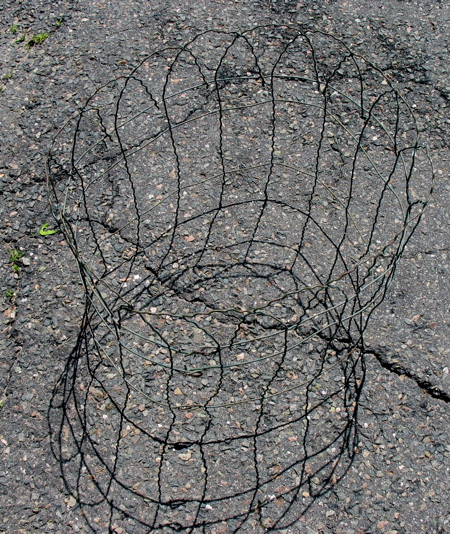
some garden fencing that was stuck up in the rafters of the garage, already starting on the biodegrading part- ie rusty.

compost from my compost pile

commercial potting soil

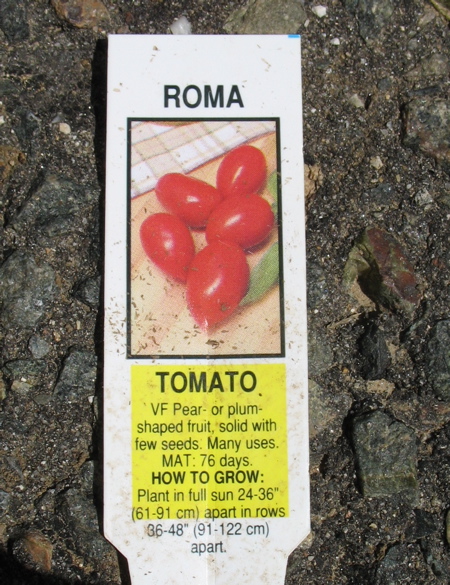
tomato plant

Step 1: Cut the label out of the shirt since it is probably not cotton and wouldn’t decompose.


Step 2: Make a circle shape out of the wire fencing. Mine is about 16 inches across.


Step 3: Place in the garden and push the wire prongs into the soil.

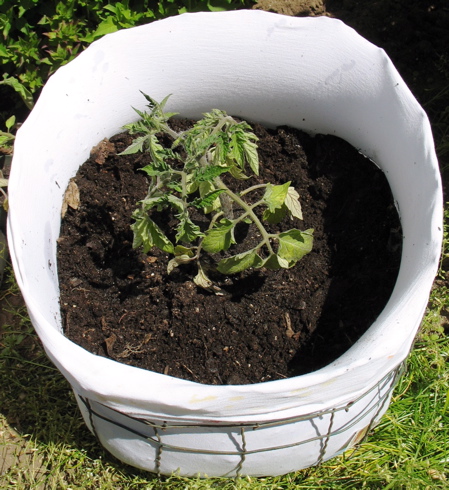
Step 4: Put the t-shirt into the circle, collar edge down. Stretch the bottom edge of the shirt around the top of the fencing. I didn’t worry about weeds underneath- whatever was there will be dead soon.


Now there is a “pot”!

Step 5: Fill it half way with compost or other clean filler dirt, like all last years window boxes that you are replanting. I used compost from my compost pile. Push and stretch out the sides of the t-shirt as you add dirt.


Step 6: Center the tomato plant on top of the compost. Loosen up the root ball.


Step 7: Use the commercial potting soil to fill in around the plant and up to an inch or so from the top. Yes, you are burying 6 inches of stem and leaves. Trust me, that is a good thing. Water thoroughly.


Step 8: Wait 2 months. Hopefully, tomatoes!


I’ve got 4 done. One more to go.

This entry was posted on Monday, May 26th, 2008 at 6:03 pm
Related Posts Plugin for WordPress, Blogger...